
Restaurant website design
Five HTML menus with prices and allergens, plus table reservations allocated against a real floor plan.
- 37 pages
- Booking app
- 52 images
$1,780$890
See detailsReady-made · live demo online
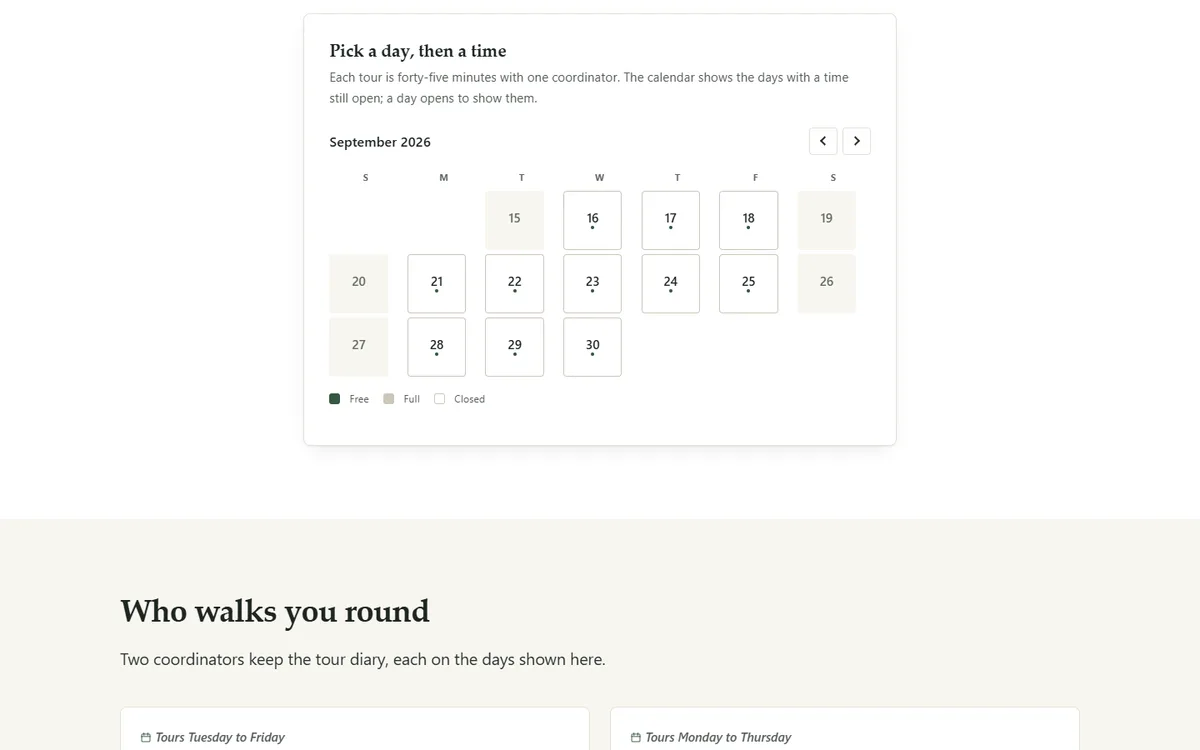
Fifty-seven pages for a restored hall with three rooms that can also be hired as one, and the software a venue actually runs on: a public calendar that shows every day as free, on hold or booked, a hold that blocks the date for seven days and then lets it go, a confirmation that beats any hold racing it, and a diary for the tours every couple books before they sign.
$1,780$890one time · live in ~10 business days
Includes your domain for a year, a year of hosting at MaiaHost, SSL, and every page rewritten around your business.
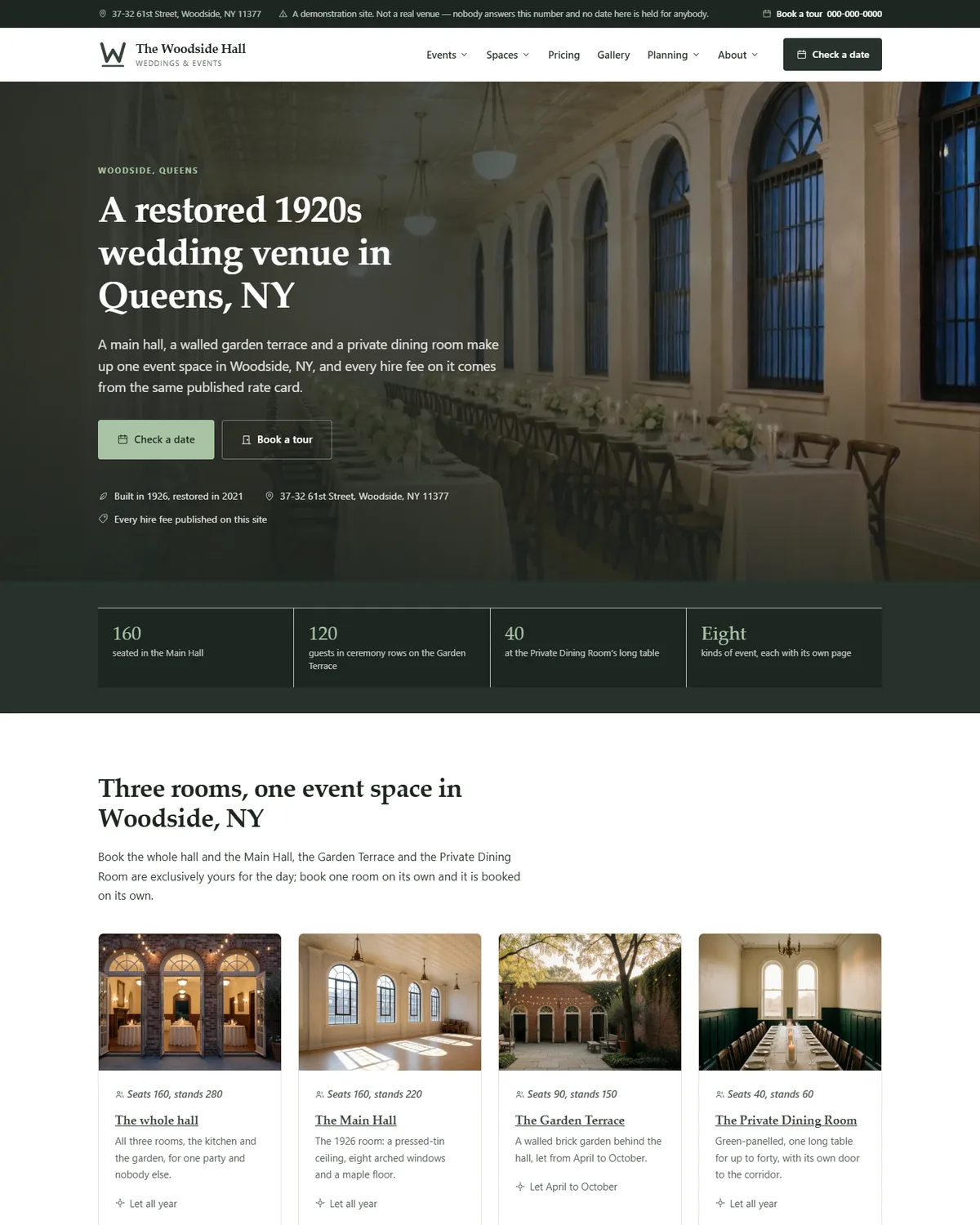
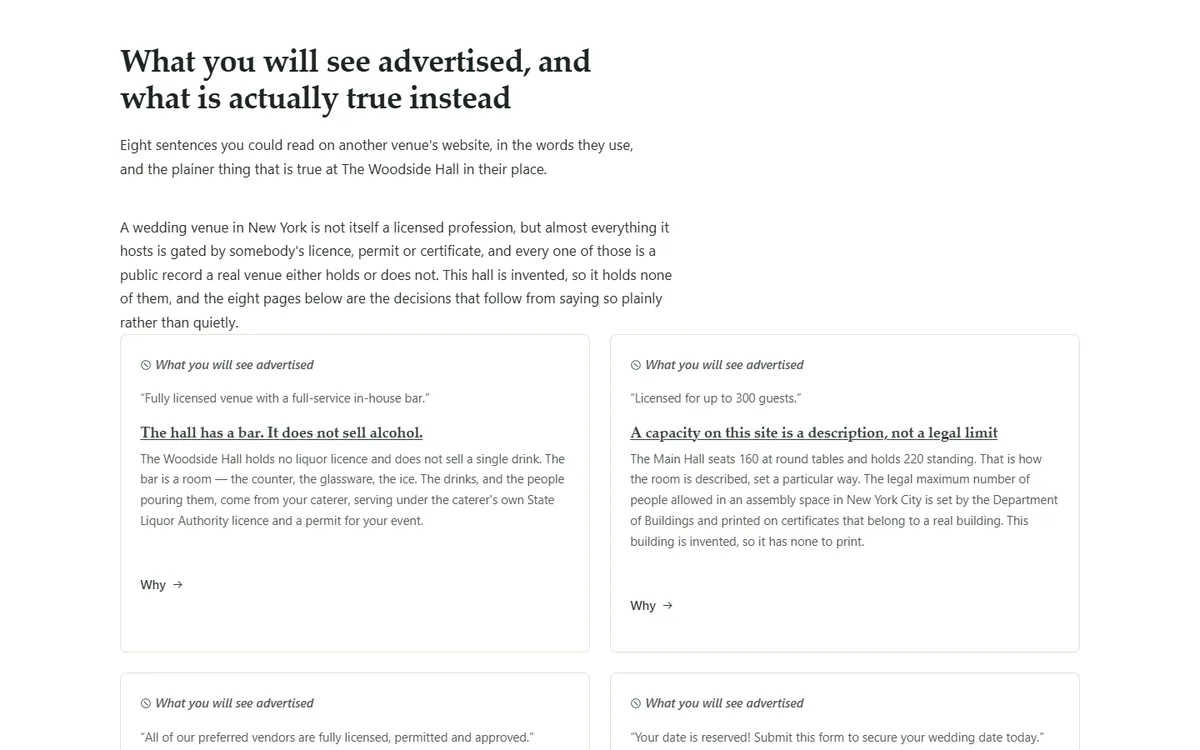
Demonstration site. The Woodside Hall, LLC is a fictional business invented for this demo — every phone number on it is literally 000-000-0000. The website itself is entirely real and built exactly as yours would be.
Why this design works for a wedding and event venue
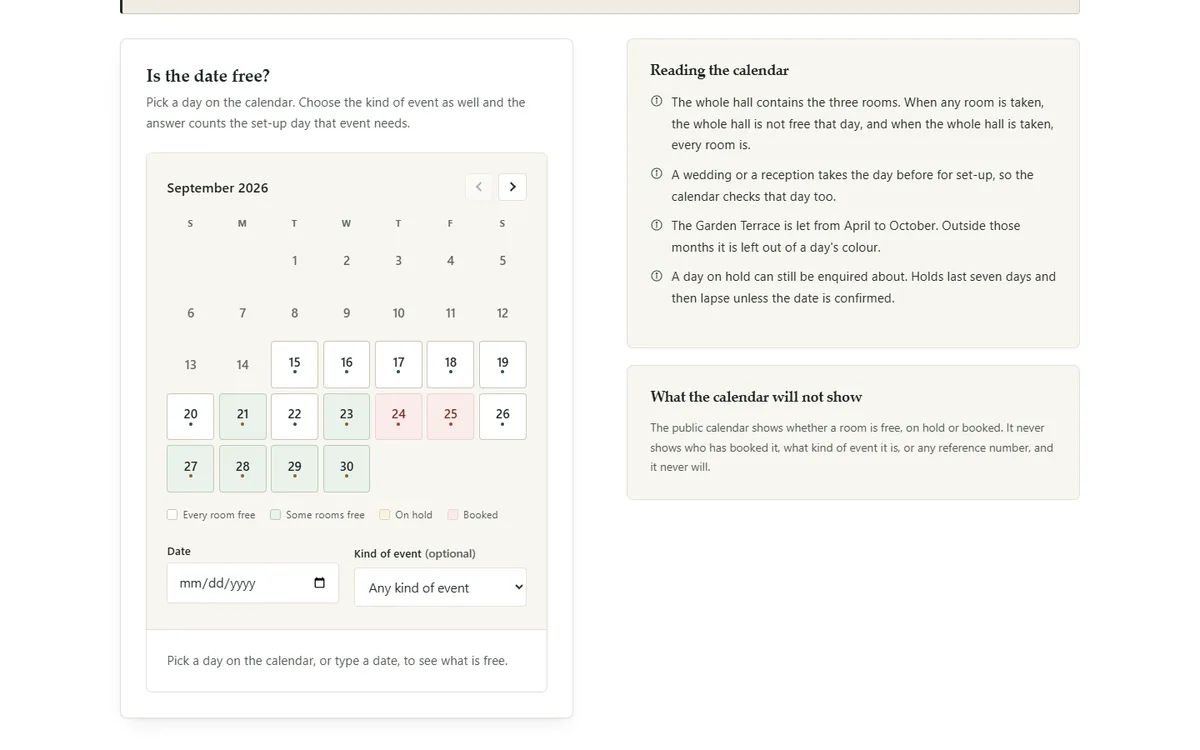
A venue does not sell a date the way a restaurant sells a table. A couple enquires, walks the rooms, asks for the date to be kept while they decide, and only signs weeks later — and the dangerous part is the middle. A “courtesy hold” written in a spreadsheet lapses without anybody noticing, or never lapses at all, and the Saturday that was quietly free is turned away twice. This design makes the hold a real thing with a real end: staff place it, the public calendar shows the day as on hold, it blocks that date for seven days (a setting the manager changes), and when it runs out the date is released and both sides are told. A signed contract confirms the date, and a confirmation can displace a hold that is racing it — on purpose, in the staff area, with the displaced couple told.
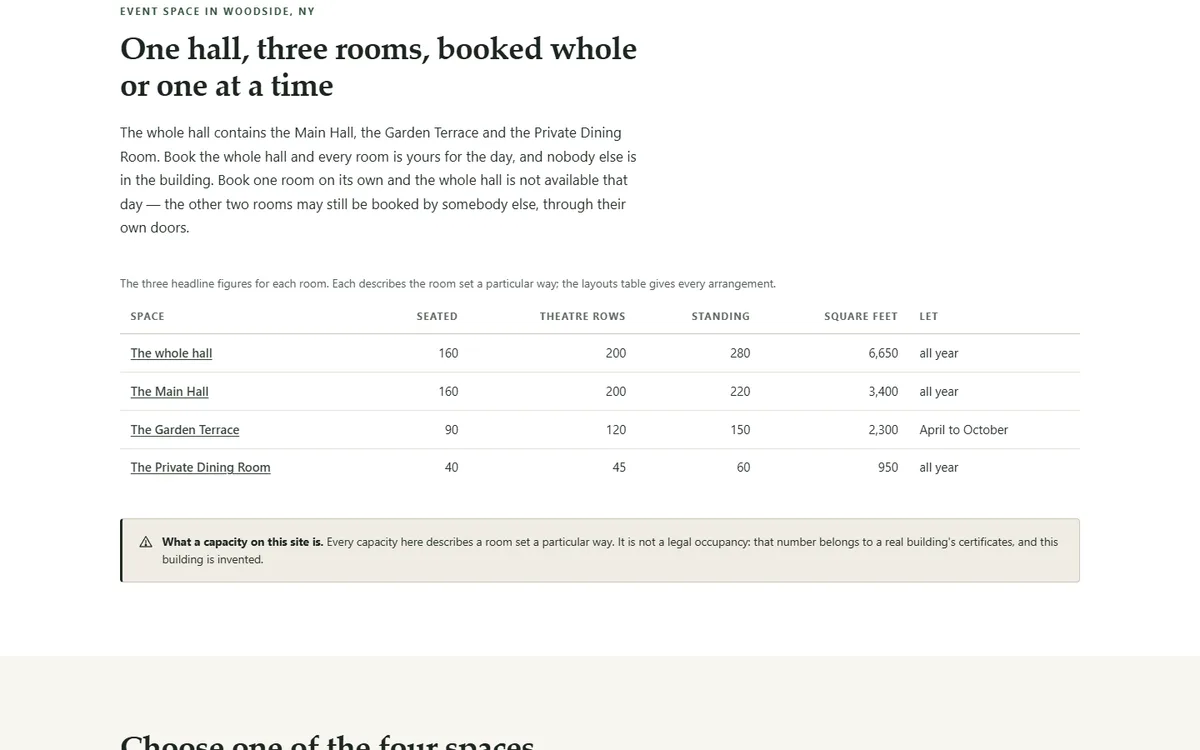
The rooms are the second half of the problem. Three rooms can be hired on their own, and the whole hall is all three at once, so a wedding that takes the building takes every room and a dinner in one room takes the building off sale. That relationship is stored as data and checked inside the transaction that places a hold, in both directions, and the day before a wedding is blocked as well because that is when the tables go in. Six simultaneous holds on one Saturday, fired from six separately signed-in staff sessions against the live site: exactly one wins.
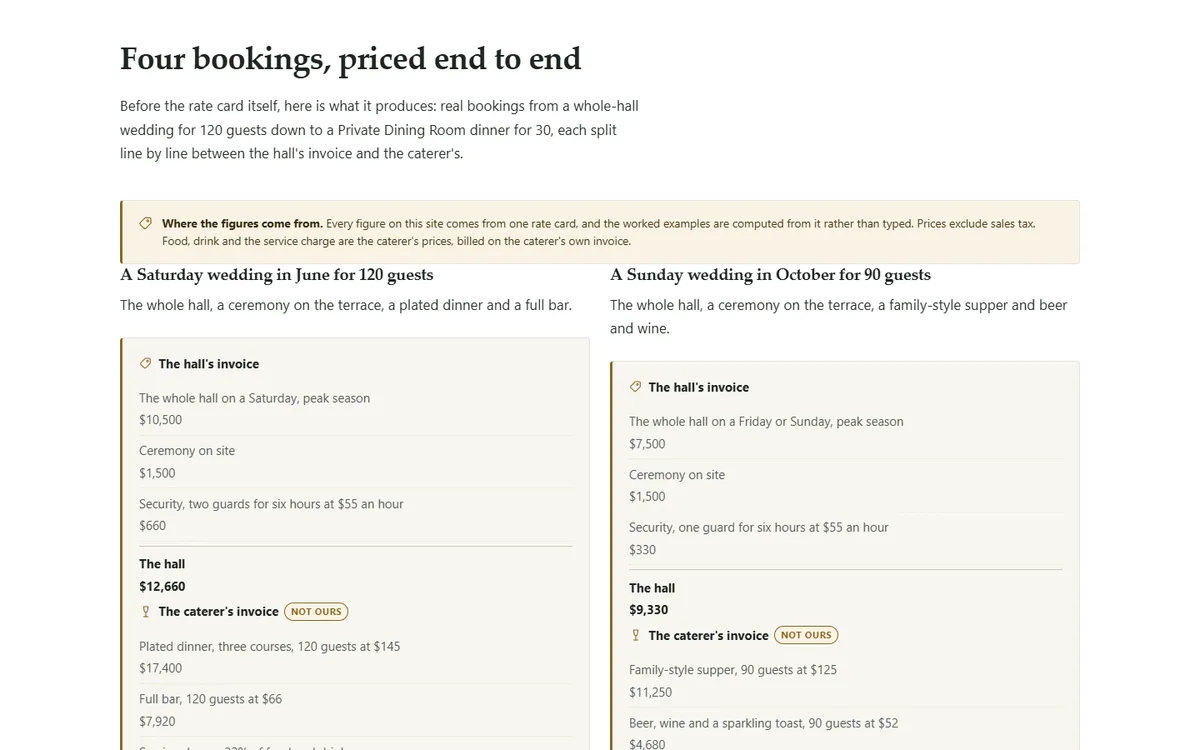
Then the money, which is where this trade loses people. Every hire fee is on the site — each space by day of the week and time of year — and four real bookings are priced end to end, split the way a venue actually invoices: the hall charges for the room, the ceremony and security, and the caterer charges for food, the bar and its service charge on its own invoice. The calendar shows the fee for any date a visitor opens. Nothing about any of it needs a telephone call to find out.
The courtesy hold is where venues lose Saturdays: written down, forgotten, never released, or released without telling anybody. Here a hold has an expiry the moment it is placed, the public calendar shows the date as on hold rather than booked, and when the time is up the date is free again — immediately, not when a job next runs — and the couple and the office are both told. The test for it places a hold that expires at once and asserts that the date is available before anything has swept it.
Book the Private Dining Room for a Tuesday dinner and the whole hall comes off sale for that day; book the whole hall and all three rooms do. The relationship is data rather than a naming habit, it is checked inside the transaction that places the hold, and it is tested against the live site in both directions — including the one everybody forgets.
A venue that does not sell food or drink sends two bills, and the pricing page shows both for four real bookings: the room, the ceremony and security on the hall's; the menu, the bar and the caterer's service charge on the caterer's. The total is at the bottom of each. A couple comparing venues can finally compare like with like.
Two coordinators placing holds on the same Saturday in the same second, or a manager confirming a date while somebody else holds it, is exactly when a spreadsheet double-books. The races are fired over the wire at the live site from separately signed-in sessions, and the result is read back from the bookings themselves rather than from whether a request came back.
Every room is empty and every table is laid for guests who have not arrived. The obvious picture for a wedding venue is somebody's wedding, and a generated one would be a wedding that never happened at a hall that does not exist. There is a page explaining how the pictures were made and the rules they followed — no faces, nothing written, flameless candles.
Screenshots from the live site
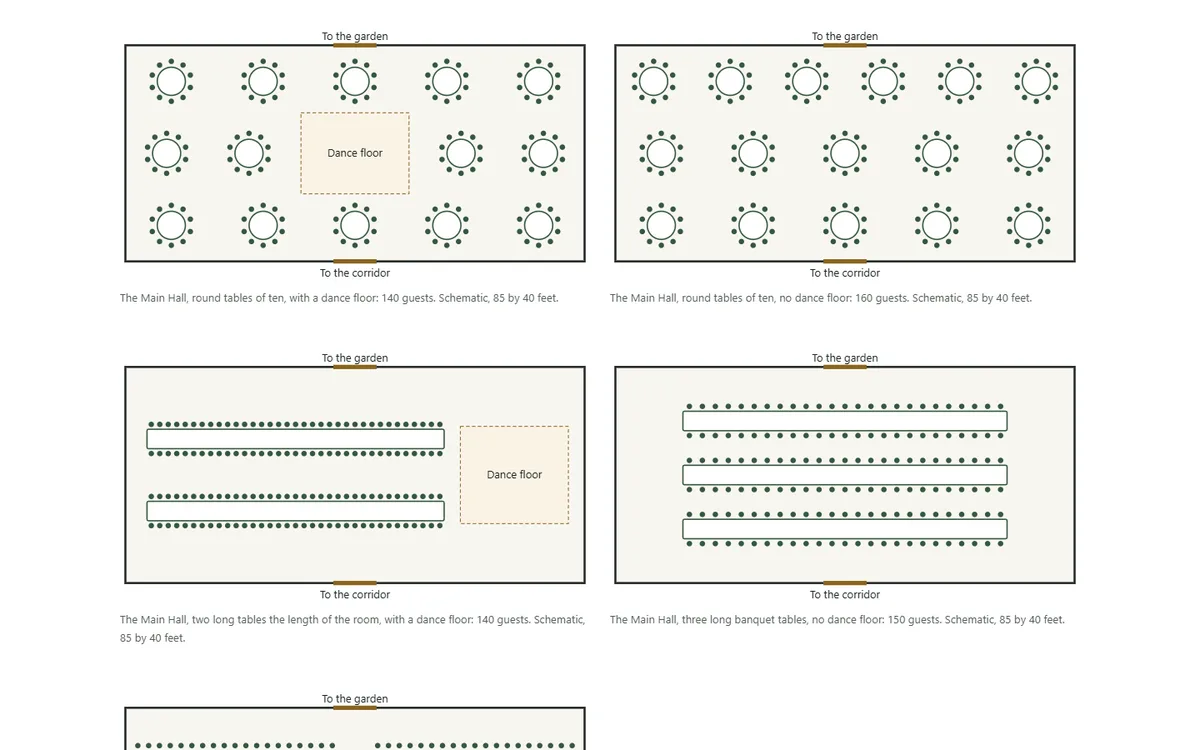
These are screenshots of the real website, taken from the live demo. Nothing here is a mockup — open it yourself and every one of these pages loads.
Mobile first, not mobile afterthought
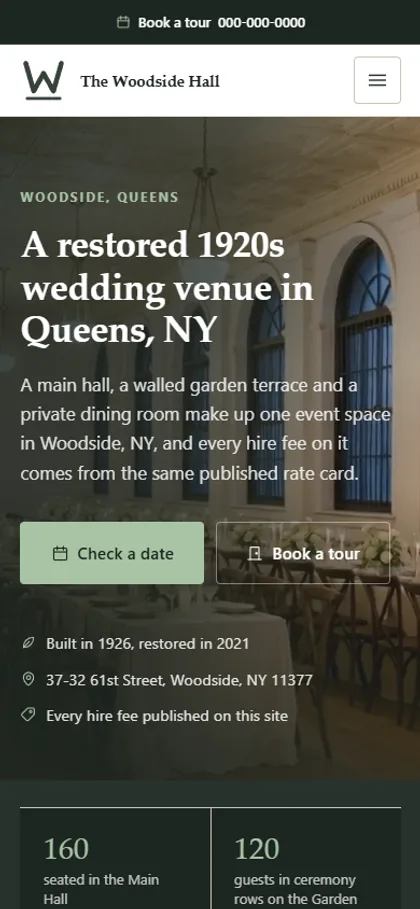
Local service searches are overwhelmingly done on phones, so the phone layout is the one we design first and test hardest. Text stays readable without zooming, the phone number stays reachable with a thumb, and nothing needs a horizontal scroll.
Every page, listed
57 indexable pages, each with its own title, description, structured data and a place in the sitemap. That is 57 chances to appear in a search instead of one.
Included — not an add-on
The pipeline a venue actually has — enquiry, hold, confirmed — with the hold as a real object that blocks a date and then expires, across spaces that contain each other, plus a separate diary for tours.
The software runs on your own hosting and belongs to you. There is no monthly licence, no per-booking commission and no third party holding your customer list — which over a few years is usually worth more than the price of the website.
What $890 covers
You get the same structure and design system with your business in it — your name, logo, colours, photographs, services, prices and locations, and every page rewritten for you. Two businesses starting from this design do not end up looking like each other.
Pages you do not need come out. Pages you need that are not there can be added at $90 each. The local SEO — titles, descriptions, structured data and the copy itself — is retargeted from Woodside to wherever you actually work.
Your domain name
First year included, registered in your name
One year of MaiaHost hosting
Fast EU LiteSpeed hosting, daily backups, 24/7 monitoring
SSL certificate
HTTPS from the first minute, auto-renewing
Your branding
Your business name, logo, colours and typography
Your content
Every page rewritten around your business, services and prices
Your photographs
Your images placed and optimized — or we keep the demo imagery
Local SEO retargeted
Titles, descriptions, schema and copy aimed at your city
Working contact form
Spam-protected, delivering to your inbox
Google Search Console
Verified and your sitemap submitted
One revision round
Tell us what to change after the first build — included
30 days of free fixes
Post-launch corrections and small tweaks on us
You own everything
Files, design, content and domain — move host any time
Who this suits
Not quite your trade? Designs adapt more easily than people expect — the structure matters far more than the industry it was written for. Tell us what you do and we will say honestly whether this one fits.
Questions
Nothing here is sized for the demo. The spaces, their capacities and which space contains which are rows, and the engine asks the containment table rather than assuming a shape — a building containing five rooms, a floor containing two, or a courtyard that goes with the ground floor. Adding a space later is an edit, not a rewrite.
The default comes from a setting the manager changes, and staff choose the length when they place each hold and can extend a hold while it is still running. What the system will not do is let a hold run on with no end date, which is the whole point of it.
Yes, and that is tested rather than assumed. Six holds on one date are fired at the live site from six separately signed-in sessions, and exactly one succeeds; a confirmation fired into five racing holds wins and no hold survives. The decision is made inside the transaction that writes the hold, against rows it has locked.
Not in this demonstration. A date is confirmed when staff tick that the contract is signed and the deposit has arrived, which is how most venues take a deposit today — by bank transfer, without card fees. Adding a payment provider is ordinary work and we will quote it.
No. It is a demonstration site, not a business: nobody answers the telephone number, no date on its calendar is held for anybody, and the site says so on every page. Every photograph was generated and nobody appears in any of them. Your version uses your rooms, your prices and your photographs.
More general questions are answered on the sample websites page.
Other ready-made designs
Five HTML menus with prices and allergens, plus table reservations allocated against a real floor plan.
$1,780$890
See detailsSix room pages with published nightly rates, and a date-range availability engine running on your own hosting.
$1,780$890
See detailsA complete price list with a length beside every line, a lookbook, and booking that reserves the real appointment length.
$1,780$890
See details$890 one time, live in ~10 business days, with your domain and a year of hosting included. Send us a short brief and you get a fixed written quote within one business day — free, no obligation.
Or call us on +1 646 736 4779 — we answer 24/7.

